When the heat index in Baton Rouge climbs past 105 degrees, your air conditioner is doing everything it possibly can. Sometimes it still cannot cool your home down to 72 degrees. Is something wrong with it, or is this just the reality of summer in south Louisiana?
Understanding how much your AC can actually cool your home, and what temperature you should be setting it to, helps you stay comfortable, protect your system, and avoid an electric bill that makes your jaw drop.
What Is the Best Temperature to Set Your AC in Summer?
The U.S. Department of Energy recommends setting your thermostat to 78 degrees Fahrenheit when you are home. That is the balance point between comfort and energy efficiency for most households.
Every degree you drop below 78 degrees adds roughly 3 percent to your cooling costs. Set your thermostat at 72 degrees instead of 78 and you are paying about 18 percent more in electricity for the same amount of time.
In Baton Rouge, where you run your AC for seven or eight months a year, that difference adds up to real money.
| Setting | Recommended For |
| 78°F | When home and active |
| 82°F to 85°F | When away from home |
| 75°F to 76°F | When sleeping |
| Never below 68°F | Setting this low risks freezing the evaporator coil |
These are starting points. Personal comfort matters. But staying close to 78 degrees while you are home is one of the most effective ways to manage your bill without sacrificing comfort.
The 20-Degree Rule: Your AC’s Actual Cooling Limit
Here is the part most homeowners never hear about, and it is important for setting realistic expectations during Baton Rouge summers.
Most residential air conditioners are designed to cool your home to about 20 degrees below the outdoor temperature. That is the standard design limit.
In real numbers for Baton Rouge:
| Outdoor Temperature | Realistic Indoor Temperature |
| 85°F | 65°F to 70°F |
| 90°F | 70°F to 75°F |
| 95°F | 75°F to 80°F |
| 100°F | 80°F to 85°F |
| 105°F | 85°F to 90°F |
Baton Rouge regularly hits 95 to 100 degrees from late June through early September, with heat index values well above that. On those days, your system is not broken if it cannot get the house to 72 degrees. It is simply reaching its physical limit. The heat pouring through your walls, roof, and windows is coming in faster than the AC can push it out.
If your thermostat is set to 72 degrees and the house is sitting at 82 degrees on a 102-degree afternoon, that is thermodynamics, not a malfunction.
If your home is consistently warmer than outdoor temperature minus 20 degrees on moderate days (say, 90 degrees outside and 80 inside), something else may be wrong. We will cover that below.
What Happens on Extreme Heat Days in Baton Rouge
When outdoor temperatures hit 100 degrees or above, your AC will likely run almost continuously. That is not a problem. It is the system doing exactly what it was designed to do under extraordinary conditions.
On those days:
Your home will probably be warmer than your ideal setting. If it is 102 degrees outside, a 72-degree indoor temperature is not achievable. Setting the thermostat to 78 or 80 gives the system a target it can actually hit while still providing meaningful relief.
Continuous runtime is normal. Your AC is built to handle extended operation. What shortens system life is constant rapid cycling on and off, which is what happens with an oversized system. A properly sized system running steadily for hours is healthier for the equipment than one that cycles every few minutes.
Humidity compounds everything. On a 95-degree day with 85 percent outdoor humidity, the heat index can exceed 110 degrees. Your body cools itself by sweating, and high humidity slows evaporation significantly. A home at 78 degrees and 45 percent indoor humidity feels much more comfortable than a home at 78 degrees and 65 percent humidity. Temperature is only part of the comfort equation in south Louisiana.
Smart Temperature Strategies That Save Real Money
Raise the Temperature When You Leave
When nobody is home, raise the thermostat 7 to 10 degrees. There is no reason to cool an empty house to 78 degrees. Setting it to 85 or 88 while you are away saves significant electricity without causing any discomfort.
Do not turn the AC off completely. Coming home to a house at 100 degrees means your system has to pull the temperature down 25 degrees or more, which costs more than maintaining a higher setpoint all day.
Use a Smart Thermostat
A smart thermostat is one of the most practical upgrades for a Baton Rouge home. It learns your schedule, adjusts automatically, and can be managed from your phone. You can have your home cooled back down to 78 before you arrive without ever thinking about it.
Many smart thermostats also display indoor humidity levels. In Louisiana, monitoring both temperature and humidity gives you a much more complete picture of your home’s actual comfort level.
Keep Blinds Closed During Peak Heat
Direct sunlight through south and west-facing windows adds substantial heat to your living spaces. Closing blinds or curtains between about 2 p.m. and 6 p.m. can reduce indoor heat gain meaningfully without touching the thermostat.
Why Humidity Makes Your Home Feel Hotter Than It Is
This is especially relevant for Baton Rouge.
High indoor humidity slows the evaporation of sweat from your skin, which is your body’s primary cooling mechanism. A home at 78 degrees and 65 percent humidity feels significantly hotter and stickier than a home at 78 degrees and 48 percent humidity.
Managing indoor humidity so your home feels comfortable at a higher thermostat setting is one of the most practical ways to reduce your electric bill without sacrificing comfort. Our indoor air quality team can help you find the right dehumidification solution for your home.
Reasons Your AC Is Struggling More Than It Should
If your home is consistently warmer than the 20-degree rule predicts on moderate days, your system likely has an issue beyond just extreme outdoor heat.
Undersized system: It runs constantly and cannot keep up even in moderate conditions.
Oversized system: It short-cycles, never removes enough humidity, and the home feels uncomfortable at the same temperature it used to feel fine at.
Dirty air filter: A clogged filter restricts airflow across the evaporator coil, significantly reducing cooling capacity. Check your filter and change it every 30 to 90 days.
Dirty coils: The outdoor condenser coil releases heat from inside your home to the outside. If it is coated with dirt or debris, it cannot do this efficiently. The indoor coil has the same issue.
Low refrigerant: Refrigerant carries heat from inside to outside. A leak reduces the system’s cooling capacity. Signs include ice forming on the indoor unit or refrigerant lines, or the system running for a long time without cooling much.
Leaky ducts: Ducts that leak allow conditioned air to escape before reaching your living spaces. Baton Rouge homes, especially older ones, frequently have significant duct leakage. Our duct sealing service addresses this directly.
Things You Can Do to Help Your AC on Hot Days
- Run ceiling fans. They make you feel cooler by moving air across your skin. A ceiling fan does not lower air temperature, but it lets you tolerate a thermostat setting 2 to 4 degrees higher in comfort. Ask about our ceiling fan installation service.
- Avoid heat-generating activities during peak hours. Cooking on the stove, running the dishwasher, and using the clothes dryer all add heat to your home. Shift these to morning or evening when possible.
- Check attic insulation. Most of the heat entering a south Louisiana home in summer comes through the roof. Poor attic insulation allows that heat to radiate down through the ceiling all afternoon.
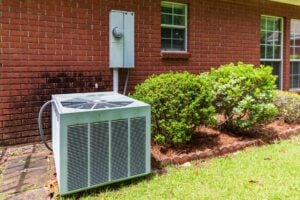
- Keep the outdoor unit clear. Clear at least two feet around the outdoor condenser. Plants, furniture, and debris block airflow and make it harder for the unit to release heat.
When Struggling AC Means Something Is Wrong
There is a difference between a system working hard because it is 103 degrees outside and a system that is genuinely underperforming. Watch for:
- Home consistently warmer than outdoor temp minus 20 degrees on normal days
- Rooms significantly hotter than others for no obvious reason
- Electric bills noticeably higher than the same period last year
- Unusual sounds from the indoor or outdoor unit
- Ice forming on the coil or refrigerant lines
- Weak airflow at the supply vents
If any of these sound familiar, an AC repair visit is the right next step. If it is an emergency and your system has stopped cooling entirely, our 24/7 AC emergency service is available.